
West Melbourne Directory Shelves
West Melbourne incorporated in 1959, so its city directory trail is metropolitan rather than a long stand-alone series. Search Melbourne-area headings first, then read each volume's coverage statement for streets west of Melbourne's older limits. The official sources confirm several strong companion collections, but not a publisher-by-year local run. That gap should remain visible instead of being filled with an assumed publisher.
| Collection | Years | Where Held | Access |
|---|---|---|---|
| Melbourne-area city directories | Exact local years not exposed | State Library Florida Collection; possible Brevard library holdings | Reference inquiry and onsite use; check geographic key |
| Telephone directories | Local dates not verified | Brevard Libraries or Historical Commission inquiry | Name/address search; unlisted numbers absent |
| Federal population census | 1790 through 1950 public | NARA and partner databases | Online or library access |
| Florida Memory | Varies by collection | Florida Department of State | Online search and reference help |
| Chronicling America | Within collection limits | Library of Congress | Free OCR name and address search |
| Brevard local files | Varies | Historical Commission | Ask for maps, photos, and vertical files |
The State Library collection spans Florida directories from the early 1900s to the present, arranged by city and date. That broad range does not prove that every Melbourne year exists. Ask for a title and year shelf list, geographic coverage, reverse-section presence, and reproduction rules.
Why West Melbourne Directory Searches Shift
Brevard County dates to 1855 and took its current name in 1856. West Melbourne did not become a city until 1959. Early land, court, probate, marriage, map, and directory evidence therefore sits under county or Melbourne-area labels. A modern West Melbourne parcel can also keep “Melbourne” as its mailing city.
Read the coverage key before the alphabetical names. It tells whether the publisher included outlying streets, subdivisions, or a broader metro area. For a pre-1959 address, also search the subdivision and legal description. Incorporation, postal naming, and directory coverage follow separate timelines.
Note: No official source reviewed established that any specific Melbourne volume automatically includes every present-day West Melbourne street.
West Melbourne State Directory Research
The State Library city directory collection is the authoritative first check. Reference staff can confirm holdings at 850-245-6682 before a Tallahassee visit. Ask for every Melbourne title and year, the publisher, coverage statement, reverse or street section, and copying policy.
The official directory collection page appears below.
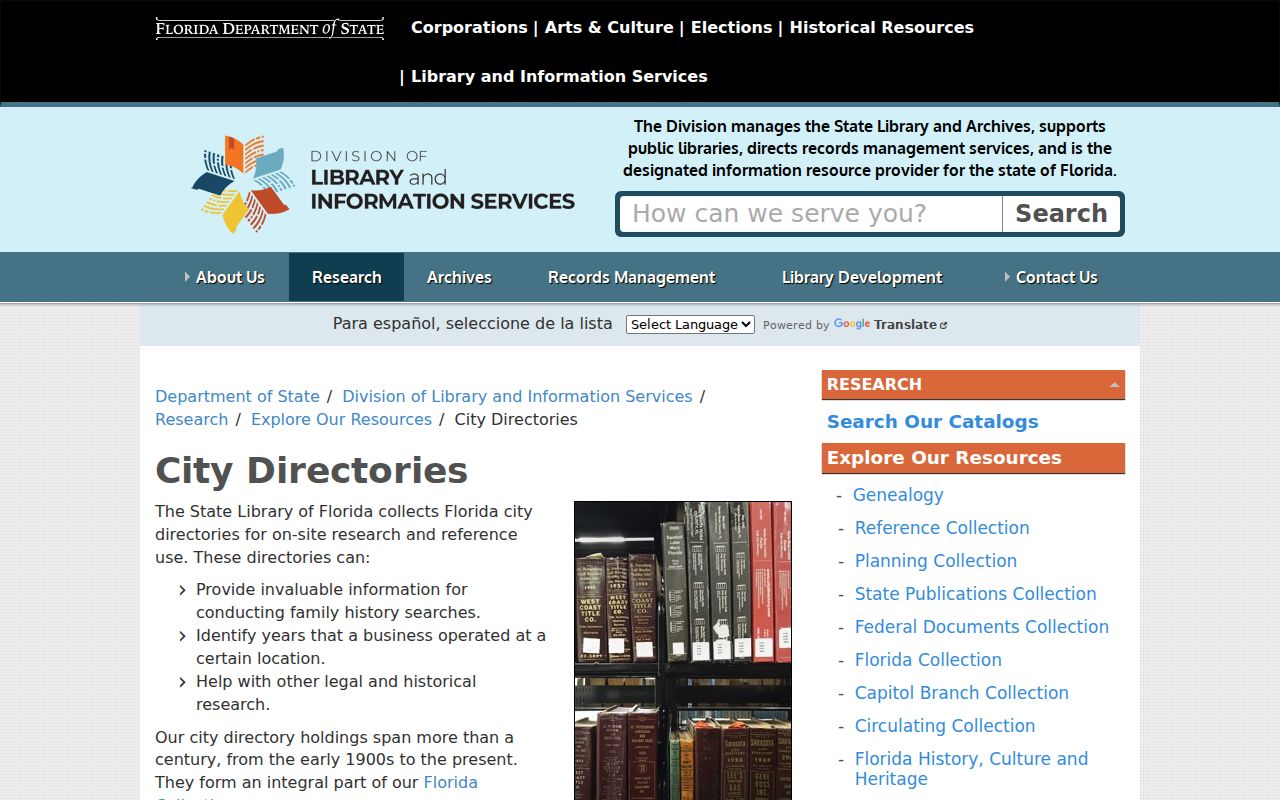
The capture identifies the state collection and searchable holdings route, not a digitized West Melbourne volume.
Some genealogy images elsewhere may require a free account, an affiliate library, or a FamilySearch Center. Licensed newspaper databases may need a Brevard library card or onsite use. Confirm access before travel.
West Melbourne Directory Archive Companions
The Brevard County Libraries catalog and reference staff can check city directories, telephone books, high-school yearbooks, and newspaper microfilm. The Brevard Historical Commission keeps local maps, photos, vertical files, family materials, and community history. Ask specifically for West Melbourne, Minton Road, June Park, subdivisions, and pre-1959 sources.
The broader Florida State Archives research service supplies catalog and reference routes for maps, photos, manuscripts, and government records.
This official research page helps locate statewide companion evidence when the city directory shelf has a gap.
Read a West Melbourne Directory Entry
A city directory entry is compressed. The exact symbols must be read against that volume's abbreviation key. The State Library confirms the value of directories for family and historical research, but no official open digitization supplied an actual Melbourne sample page. Treat the conventions below as fields to verify, not a claim that every local edition used them.
| Name | Surname and given name; spouse may appear in parentheses |
|---|---|
| Work | Occupation and sometimes the employer or business address |
| Address | House number and street, often with “r” for residence or “b” for business |
| Householder mark | Some editions use “h” or another key-defined symbol |
| Widow notation | “wid” may name a deceased spouse and provide a family-history lead |
- Criss-cross directory
- A section ordered by street and house number, used to turn an address into a listed name.
- Householder index
- A list centered on the person identified as the household head under that publisher's rules.
- Abbreviation key
- The volume's own legend for shortened terms and symbols. Capture it before interpreting an entry.
Reverse West Melbourne Address Searches
A later city directory may include both an alphabetical name list and a reverse street section. Start with the exact street spelling used in that year, then scan house numbers and nearby entries. The reverse section can reveal the listed householder and help show how the block changed between editions.
Do not assume that a missing address means the home was vacant. The volume may exclude that part of the metro area, the person may be unlisted, the number may have changed, or OCR may have failed. No official source located a citywide West Melbourne renumbering date, so compare the plat, parcel legal description, maps, and adjacent numbers.
Start with the volume's geographic key before searching names. A Melbourne title may cover the urban area, selected suburbs, or only streets within a stated boundary. After finding the address, photograph or cite nearby entries as well as the target line because the printed sequence can confirm that the correct street and number were read. Repeat the search under old and current street forms, and inspect the alphabetical section for the same householder. Agreement between both arrangements makes a transcription more reliable.
Pair West Melbourne Directories With 1950
The 1950 federal population census is the newest open schedule under the 72-year rule. It can add household names, relationships, ages, birthplaces, work, and address or enumeration location. Directory years on each side of 1950 help narrow arrivals, departures, and moves that the ten-year census interval misses.
West Melbourne's 1959 incorporation means a 1950 household will not be indexed under the later municipal identity. Search Melbourne, the subdivision, an older road form, and census geography. A directory occupation can help distinguish two same-name people, but it should not be used alone.
Record each source on its own timeline. A directory reflects the publisher's canvass and print cycle, while the census reflects a stated enumeration date. A deed reflects execution and recording events, and a newspaper item reflects publication. Differences among them may show an ordinary move or reporting delay rather than an error. Keep spouse names, occupations, ages, birthplaces, neighbors, and address variants as comparison points without forcing every field to agree.
Map West Melbourne Directory Clues
Library of Congress Sanborn maps can show street names, numbers, structures, footprints, and uses. No verified stand-alone West Melbourne sheet was found, so inspect Melbourne sheets and catalog coverage before drawing a conclusion. A map describes the site, not its occupant.
Florida Memory adds state maps, photographs, and manuscripts. Chronicling America provides searchable public-domain newspaper pages within its collection limits. Search surnames, street numbers, and spelling variants because old OCR often misreads small directory type. Obituaries and local news can explain why a listing ends, but family-submitted details need support from certificates, deeds, or probate.
Brevard Historical Commission collections can add county maps, photographs, vertical files, and family or community material. Brevard Libraries may also provide licensed newspaper resources that require a library card or on-site terminal. The State Archives catalog extends the search to state and county records. Ask each repository for a finding aid and reproduction terms, and note when a source is an index, a transcript, or an original image. That distinction prevents a later citation from claiming more than the item actually shows.
Trace West Melbourne Directory Families
A West Melbourne city directory trail is strongest when each volume is documented as an artifact. Save the title page, date, publisher, coverage statement, and abbreviation key with the entry. Then move one available volume at a time. That practice separates a true move or changed work entry from a publisher's changed scope.
- Begin with one known person, year, or address and verify that the volume covers the street.
- Capture the full entry and key, then note spouse, work, residence, and householder marks.
- Move to the next available year and record first appearance, address changes, and disappearance.
- Use the reverse section to check the address and nearby listed households.
- Pair the run with the 1950 census, deeds for ownership, and probate or obituaries when a listing ends.
Disappearance can mean death, a move, an unlisted choice, a missed edition, or a changed coverage boundary. Test each possibility. Deeds distinguish owner from occupant, while census and directory entries can supply household evidence. For the current parcel chain, shift to the West Melbourne street directory instead of extending a historical listing into the present.
When a person disappears from the run, search probate and obituaries by name and period, then compare a possible successor at the same address. If the address vanishes too, examine subdivision maps, aerials, permits, and parcel history for demolition, new construction, or a changed number. No verified West Melbourne house-history guide or local Sanborn year list was found in the official research, so those sources must be checked by catalog coverage rather than assumed.
Label every unresolved gap instead of filling it with a guessed year, publisher, or household identity.